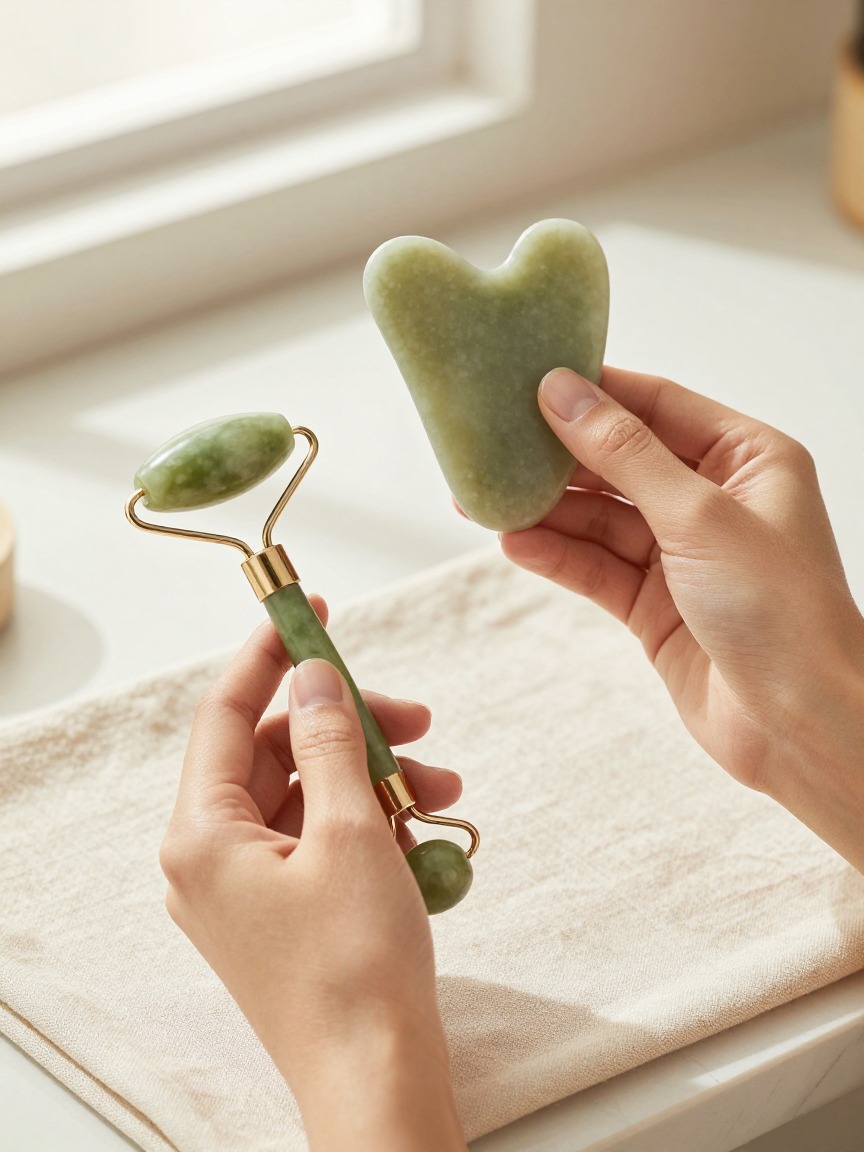
Gua Sha vs. Jade Roller: Which One Should You Actually Buy
These two tools get lumped together constantly, but they work differently. Picking the wrong one for your patience level and skin sensitivity is a common reason people abandon facial massage tools after a week.
Different Tools, Different TCM Origins
Gua sha is the older practice — a flat stone scraped against the skin, adapted from a body technique used in Traditional Chinese Medicine (TCM) for centuries. Jade rolling is a much more recent beauty-industry invention: a stone wheel on a handle that rolls rather than scrapes. Despite the name, most modern "jade" rollers sold at accessible prices are dyed quartzite, rose quartz, or a jade-adjacent stone rather than true nephrite jade. That doesn't make them ineffective, just worth knowing if authenticity matters to you.
Technique: Scraping vs. Rolling, Angle & Pressure
A gua sha stone requires you to hold a consistent angle and apply directional pressure yourself. That gives you real control over exactly where and how hard you're working — useful for a genuinely tense jaw or one specific puffy spot. A roller does the work passively as you push it across your skin. There's very little technique to get wrong, which is exactly why it's the better starting point for a first-time buyer.
Sensitive Skin, Precision & the Learning Curve
Most people find a roller pleasant from the very first use — it's hard to use one incorrectly, which makes it a safer starting point for sensitive skin. Gua sha has a steeper learning curve. The wrong angle, too upright instead of nearly flat against the skin, causes dragging and discomfort. It takes a few sessions to find a pressure and angle that feels good instead of scratchy. Once you've got the technique, though, gua sha tends to feel more effective, because the added precision lets you target exactly where you're holding tension.
Which Is Better for Circulation, Puffiness & Travel
- Sensitive or reactive skin: a roller, for lower risk of pressing too hard
- Targeting a specific tense area like the jaw or under the cheekbones: gua sha, for more precise pressure control
- A quick daily habit to support circulation: a roller, faster and easier to do while distracted
- A slower, more ritual-like evening routine: gua sha, since it forces you to slow down and pay attention
- Travel or gym bag: a roller, since most designs are more compact and less breakable than a flat stone
- Reducing morning puffiness fast: a chilled roller kept in the fridge is the quicker option
- Your first tool ever: a roller, then graduate to gua sha once you're comfortable with facial massage generally
Rose Quartz Cost and Durability
As a general category, jade rollers tend to sit at the more affordable end. Gua sha stones vary more widely depending on the material and where they're sourced — carved bian stone and true jade command a premium over dyed quartzite, rose quartz, or resin. Kitsch's rose quartz stone, for example, keeps the entry price low. Whichever you choose, a solid stone tool with no glued-on parts will outlast a cheaper hybrid design. The roller head on lower-quality tools is usually the first thing to loosen or stop spinning smoothly.
Do You Need Both?
Plenty of people end up owning one of each and use them for different moods or times of day — a roller kept in the fridge for a quick morning de-puff, and a gua sha stone for a slower nightly routine. Neither is objectively superior. They're different tools for a similar underlying benefit: temporary fluid movement and relaxation. The "right" one is whichever you'll actually pick up consistently.
The Honest Verdict
Don't let marketing convince you that jade rolling and gua sha produce meaningfully different results. The physiological mechanism behind both — moving fluid, relaxing muscle, warming skin — is essentially the same regardless of tool shape. The real difference is user experience: control and precision with gua sha, ease and speed with a roller. Buy based on which one you'll actually use three times a week for the next year, not which one photographs better.