How micro-channels trigger collagen production
A derma roller creates tiny punctures called micro-channels. That controlled disruption tells skin to ramp up its own collagen production. Over time, that process can smooth texture and soften the look of fine lines.
Needle length and needle depth: the whole decision
Every derma roller on this list uses needles between 0.2mm and 0.3mm. That needle depth works on the very top layer of skin, the epidermis, without breaking deep into the dermis. It's the line between an at-home cosmetic tool and a clinical-strength device. Rollers with needles longer than 0.5mm can cause real bleeding. They're harder to sanitize effectively between uses. They're meant for a trained professional, not your bathroom counter. If a roller doesn't clearly list its needle length in millimeters, don't buy it.
Titanium vs. stainless steel needles
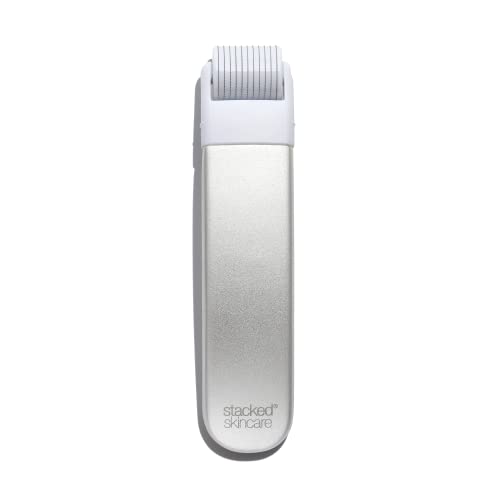
Most reputable at-home rollers use titanium or surgical-grade stainless steel needles. Both hold a fine point without bending or corroding as fast as cheaper alloys. A dull or bent needle scratches more than it pierces, which raises irritation risk without adding any benefit. Cheap, unbranded rollers sold in bulk multi-packs online are the most common source of bent needles. Stick with an established skincare brand such as BeautyBio, StackedSkincare, or ORA.
Skin texture, fine lines, acne scars & sensitive skin: who this helps
At-home derma rolling suits people managing early fine lines, uneven skin texture, dullness, or old acne scars that have already healed and flattened. It is not appropriate for active acne, cystic breakouts, open wounds, cold sores, eczema, or psoriasis flares. Skip it too if you have rosacea that's currently inflamed, sensitive skin with a current infection, or any active flare — rolling over active breakouts can spread bacteria deeper into the skin and worsen scarring. If you're on isotretinoin (Accutane) or have used it in the past six months, skip microneedling entirely and ask your dermatologist when it's safe to resume. Anyone who is keloid-prone, has a bleeding disorder, or is pregnant should check with a doctor first. This is general information, not medical advice.
Vibration motors, replacement heads and other convenience features
Some at-home rollers add a vibration motor to distribute pressure more evenly than manual rolling alone. Motorized tools also tend to sell matched replacement heads, so you can swap in fresh needles on a schedule instead of replacing the whole device. That convenience costs more than a basic manual roller, though the needle depth and safety rules stay the same either way.
How to sanitize with isopropyl alcohol and roll safely
- Sanitize the roller with 70% isopropyl alcohol before and after every use, and let it air dry — never share a roller with anyone else.
- Cleanse skin and let it dry fully before rolling; rolling on damp or dirty skin pushes contaminants into the micro-channels you're creating.
- Use light, even pressure in a few directions per section — you're not trying to draw blood, and pinpoint bleeding means you're pressing too hard.
- Apply a gentle, fragrance-free serum right after, and skip retinoids, vitamin C, and exfoliating acids for the rest of that day.
- Replace the roller head every 2–3 months, sooner if pins look bent or dull.
Serum absorption after rolling, and when to see a dermatologist instead
Right after rolling, skin temporarily absorbs serum better than usual, which is why a gentle, fragrance-free formula works best in that window. If you want more dramatic results — deeper acne scarring, sun damage, or stretch marks — that's a job for a dermatologist or licensed provider. Professional-grade microneedling typically starts at 1.0mm or deeper. Home rollers aren't built or licensed for that depth, and going deeper on your own meaningfully raises the risk of infection and scarring.
Spend vs. save: what a higher price actually buys
With at-home rollers, a higher price usually buys a vibration motor, matched replacement heads, or a nicer handle, not a safer or deeper needle, since the safe at-home depth is fixed regardless of cost. Spend up only if a motorized feature or a tidy head-replacement system will genuinely keep you consistent and hygienic. A simple, well-made manual roller from an established brand is a sensible first buy, and a dermatologist-developed budget option covers the basics without gimmicks.
A quick buying checklist, and the mistakes that waste money
- Confirm the needle length in millimeters is printed clearly, and skip any seller that hides it.
- Choose titanium or surgical stainless steel over cheap unbranded alloys sold in bulk multi-packs.
- Factor in the ongoing cost of replacement heads, not just the sticker price of the device.
- Don't buy a longer 1.0mm-plus roller for home use to chase stronger results; that's a professional's tool, and buying deeper is a safety mistake, not a saving.